
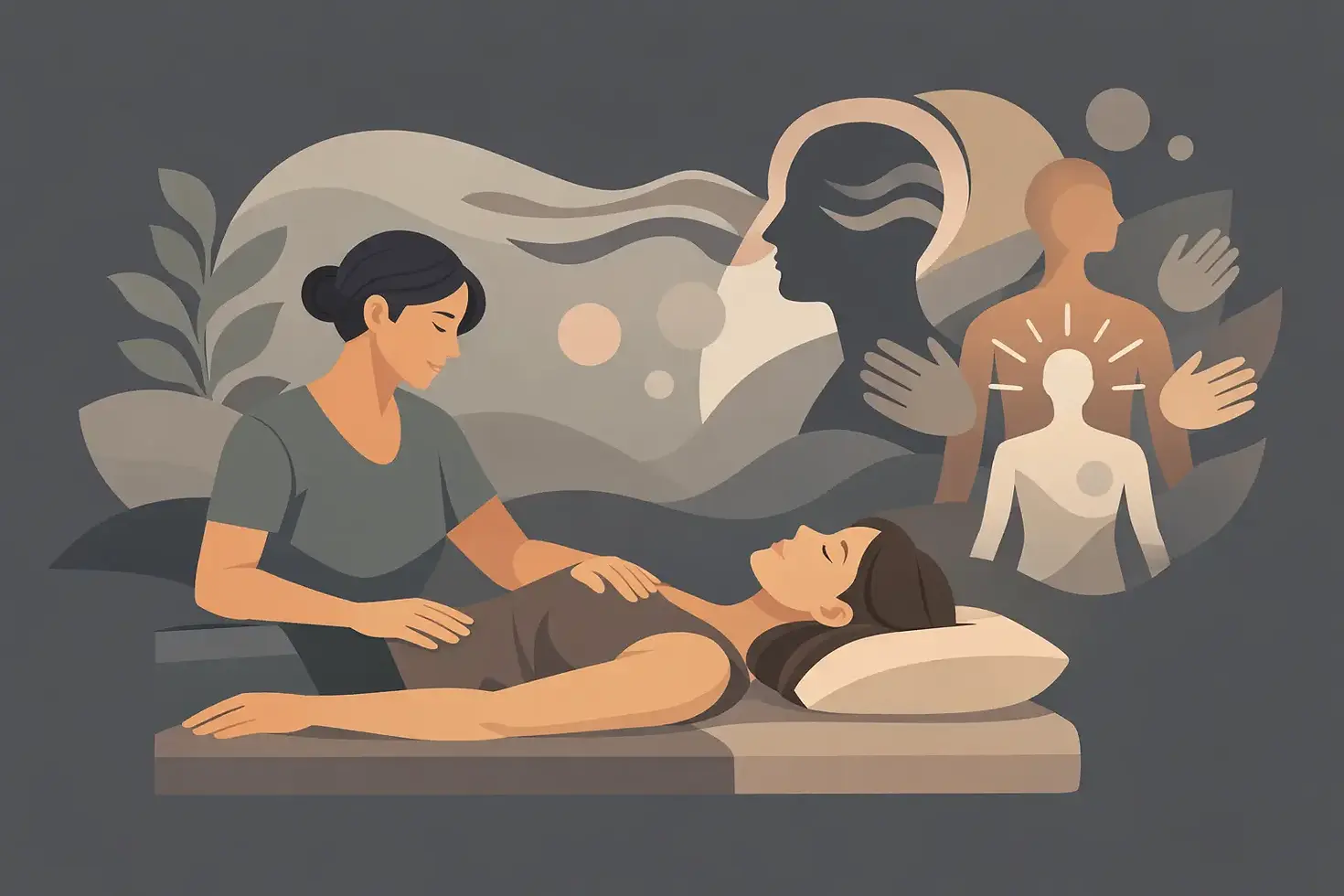
What Hands On Somatic Therapy Really Does

Some patterns do not change because they were never formed through words alone. You can understand your history, name your triggers, and still feel the same tightening in your chest, the same collapse in posture, the same bracing in your jaw or belly when life asks more of you. Hands on somatic therapy matters here because it works with the place those patterns are actually organized - in the living relationship between body, emotion, breath, sensation, and meaning.
This is not touch added onto therapy as a soothing extra. At its best, it is a precise clinical and relational process. The practitioner is not trying to force release, override your defenses, or create a dramatic experience. They are attending to how your system has learned to organize itself, and using touch, verbal guidance, and careful tracking to support change from within that organization rather than against it.
What hands on somatic therapy is
Hands on somatic therapy is a body-based therapeutic approach that includes direct touch as part of the healing process. That touch is used intentionally, not casually. It may support awareness, regulation, boundary development, emotional processing, postural change, or access to areas of chronic holding that a client cannot fully sense or shift on their own.
What makes this work distinct from massage or purely relaxation-based bodywork is its therapeutic frame. The focus is not simply muscular relief, although that may happen. The focus is how physical patterns and psychological patterns are linked. A lifted chest can be part of pride, defense, fear, or effort. A held diaphragm can reflect long-term inhibition of grief, anger, or spontaneous expression. Numbness in the belly may not be a problem to eliminate quickly, but an adaptation that once helped a person survive overwhelming conditions.
In that sense, touch becomes a way of entering the whole human system with more precision. It allows the work to include what is being said, what is being felt, what is not yet conscious, and what the body is already expressing.
Why touch can reach what insight alone cannot
Many people come to somatic work after years of insight. They are not lacking intelligence. They may know exactly why they struggle in relationships, why they overwork, why rest feels unsafe, or why certain emotions disappear the moment they arise. But understanding a pattern is not the same as having the organism reorganize it.
The body does not change primarily through explanation. It changes through experience. If a person has spent decades bracing against contact, softening that brace may require actual contact that is safe enough, attuned enough, and slow enough for the nervous system to register something new. If someone habitually leaves their body under stress, the path back may involve more than being told to ground. It may require support that helps sensation become tolerable, orientation become possible, and presence become sustainable.
This is one reason hands on somatic therapy can be so effective when other approaches stall. It works at the level where patterns are enacted, not just described. The body is not treated as a side issue to mental health. It is part of the mind in lived form.
What happens in hands on somatic therapy
A well-held session usually includes more than touch. The practitioner tracks breath, tone, impulse, posture, emotion, image, and language. They listen not only for content, but for organization. Where does activation rise? Where does expression stop? What happens when attention moves inward? What changes when support is offered physically rather than verbally?
Touch may be light or more structurally engaged, depending on the method and the intention. Sometimes it supports settling and contact. Sometimes it helps a client sense a boundary more clearly. Sometimes it brings awareness to an area that has been chronically armored or absent from consciousness. In deeper work, touch can become part of processing unfinished responses - the reaching, pushing, turning, protecting, or yielding that never fully completed when the original stress occurred.
The pace matters. Faster is not deeper. Intensity is not the same as integration. A skilled practitioner does not chase catharsis for its own sake. They help the client remain connected enough to feel, differentiate, and metabolize experience rather than get flooded by it.
The body is not separate from emotion or belief
One of the limits of fragmented treatment models is that they split what is naturally unified. A person may be sent one place for mental health support, another for posture and pain, another for breath, another for stress management. But lived patterns do not divide themselves so neatly.
A collapsed sternum may be biomechanical, emotional, developmental, and relational all at once. Chronic tightening through the throat may affect voice, crying, assertiveness, and even the capacity to know what one wants. Shallow breathing may be tied to anxiety, yes, but also to long-held adaptation around visibility, control, and the fear of taking up space.
Hands on somatic therapy can be powerful because it does not force these dimensions apart. It allows the practitioner to work with structure, sensation, affect, and meaning in the same moment. For many clients, that feels less like adding one more technique and more like finally being met as a whole person.
Who this work can help
This approach often speaks strongly to two groups. The first is people who have done a great deal of inner work and still feel that certain patterns remain stubbornly embodied. They may function well, but carry recurring anxiety, relational defensiveness, numbness, burnout, shame, or a sense that their body never quite got the memo that life has changed.
The second is practitioners who can feel the limits of working only through cognition or conversation. Psychotherapists, coaches, bodyworkers, and trauma-informed professionals often recognize that clients organize experience physically in every session. Shoulders lift. Breath stops. Eyes lose focus. The torso braces while the story remains coherent. Without somatic skill, these moments may be noticed but not fully worked with.
For professionals, hands on work adds possibility, but it also adds responsibility. Touch is not a shortcut to depth. It requires training, consent, boundaries, discernment, and an understanding of how to work with activation without imposing interpretation or pressure.
What good practice looks like
The quality of this work depends less on whether touch is used and more on how it is used. Ethical, skillful hands on somatic therapy is collaborative. Consent is ongoing, not assumed. The practitioner explains what they are doing and why. The client has room to pause, decline, question, or redirect at any point.
Good practice also respects complexity. Not every client benefits from the same amount of contact. For some, touch immediately increases safety and presence. For others, it brings up vigilance, compliance, confusion, or old relational dynamics. That does not mean touch is wrong. It means the work has to be specific enough to include those responses rather than ignore them.
This is where rigorous training matters. A sophisticated method does not treat symptoms as isolated problems to erase. It understands adaptations as meaningful and works with them accordingly. The aim is not to make a person perform relaxation or vulnerability. The aim is to support a deeper reorganization in how they inhabit themselves.
A note for professionals considering training
If you are already working in healing professions, learning hands on somatic therapy may change more than your skill set. It may change how you understand change itself. You begin to see that emotional process is postural, that belief is often muscular, that relational history lives in breath rhythm, contact tolerance, and the body's reflexive choices.
That shift can make your work more accurate and more humane. It can also expose gaps in training that many practitioners have quietly felt for years. Knowing how to talk about trauma is not the same as knowing how to work with the body that is still living it.
This is part of why integrated training models matter. Methods such as Enrootment Method are compelling not because they add bodywork onto psychology, but because they train practitioners to work with psyche and body as one system.
What to look for if you want this kind of support
If you are seeking a practitioner, look for someone who can explain their framework clearly, works with explicit consent, and does not promise quick transformation through intensity. You want someone who can stay grounded in both emotional depth and clinical responsibility.
It also helps to notice your own response. Do you feel pressured, idealized, or interpreted too quickly? Or do you feel met, informed, and included in the process? In good somatic work, the relationship itself supports embodiment. You are not handled as a project. You are accompanied in learning how to inhabit your system with more truth, capacity, and choice.
Real change often begins quietly. A fuller breath. A clearer no. Less effort in the spine. More room for grief without collapse. The body does not need to be conquered to heal. It needs to be listened to closely enough that its patterns can finally evolve.


_edited.jpg)
Comments